Expanded media coverage, endorsement deals and national exposure are reshaping how WNBA players earn — but the biggest rewards still belong to a select group of stars.

by John Brickley
For years, the WNBA’s financial reality forced many of its stars to pack their bags as soon as the season ended. Players boarded flights to Russia, Turkey and China, chasing the salaries the league at home could not yet provide.
Now, a new milestone suggests the economics of women’s basketball may finally be shifting.
For the first time, select WNBA players are earning more than $1 million annually through a combination of league salary, endorsements, media exposure and brand partnerships. The breakthrough reflects rising investment in the league — but also the growing influence of storytelling, broadcast visibility and player branding in today’s sports economics.
The milestone also raises a larger question: does the WNBA’s financial surge represent sustainable growth for the league as a whole, or does the new wealth remain concentrated among a small group of marketable stars?
Broadcasters, analysts and producers across the league say visibility — and the stories built around players — plays a central role in determining who reaches that financial threshold.
How Million-Dollar Earnings Are Built
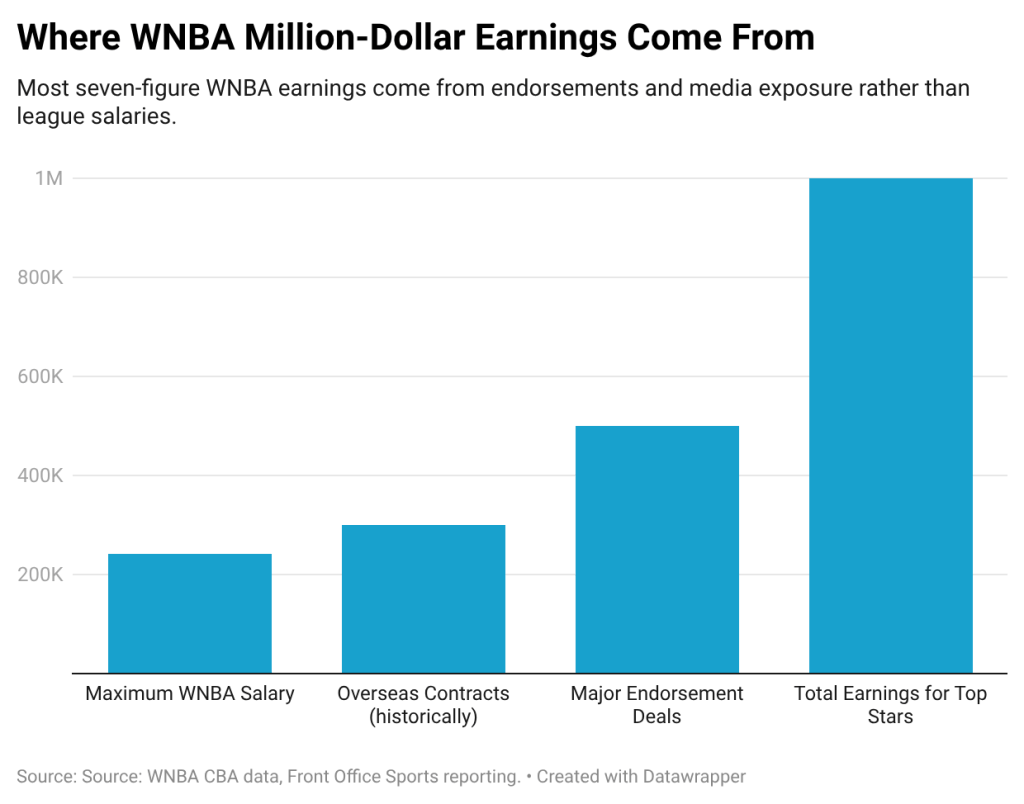
Unlike many men’s professional leagues, seven-figure income in the WNBA rarely comes from salary alone.
The league’s current maximum salary remains under $250,000 per season. Reporting from Front Office Sports shows that endorsement deals and corporate partnerships account for the majority of income for players who reach the million-dollar mark.
Edona Thaqi, a WNBA commentator for USA Network, says media narratives often determine which players break into mainstream visibility.
“Media narratives play a major role in determining which WNBA players gain national traction,” Thaqi said. “Strong on-court performance is essential, but storytelling — rivalries, personality, cultural impact and social presence — often determines who breaks into mainstream visibility.”
Players who connect with audiences beyond basketball frequently see the largest financial rewards.
“In today’s media environment, earning power is closely tied to how well a player’s story connects beyond basketball audiences,” Thaqi said.
The Power of the Player Story
For broadcasters calling games, storytelling has become central to how fans connect with players.
Brendan Glasheen, the voice of the Connecticut Sun and a broadcaster for the women’s basketball venture Unrivaled, says modern sports fandom often revolves around individual stars.
“We are in an era now where sports fandom extends to individual greatness,” Glasheen said. “You might watch a team because you are a fan of an individual. In women’s and men’s basketball, star players have large brands and fans gravitate to them.”
Broadcasts often help build those narratives.
“When done right, sports broadcast provides a platform to boost or amplify a player’s brand,” Glasheen said. “The game still matters — but sometimes the game is the roadmap and the star player is the vehicle.”
Fans increasingly follow players across teams and platforms.
“Fans want to relate to their favorite players,” Glasheen said. “Many young players are making way more off the court. Intertwine the two — it’s part of the story.”
Broadcast Visibility and Market Value
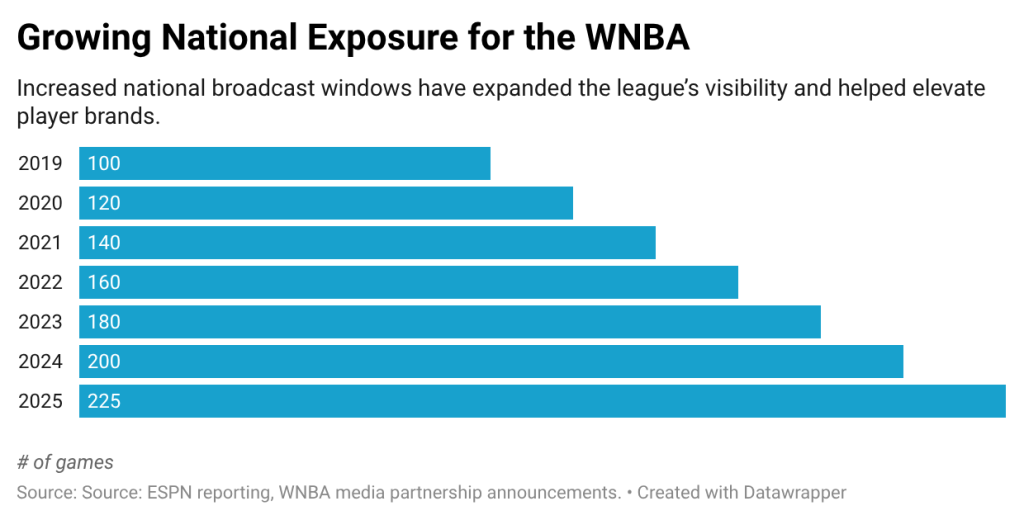
National television exposure plays a major role in determining which players gain endorsement opportunities.
Andy Bock, a producer for the Connecticut Sun and national WNBA broadcasts on ION, says production decisions often center around athletes who drive ratings.
“Broadcast visibility plus aggressive marketing of a star player are the two biggest factors,” Bock said.
The approach mirrors how networks promote NBA games.
“You never see an NBA game promo that doesn’t feature stars like LeBron, Steph, Luka or Jokic if their team is playing,” Bock said.
Highlight packages and broadcast storytelling frequently center on the WNBA’s biggest names.
“Highlighting those players in broadcast opens and in-game packages is how production can directly affect market value,” Bock said.
The reason is simple.
“Stars drive ratings,” Bock said. “Ratings equal ad revenue and affiliate fees. That’s what keeps networks profitable.”
A League Still Defined by Star Power
The WNBA’s financial structure increasingly mirrors other professional sports.
A small group of elite athletes often dominates endorsement revenue.
“It’s all about the stars,” Bock said. “Ancillary players benefit slightly — like a rising tide lifting all boats — but the biggest revenue always follows the most marketable athletes.”
Glasheen says that reality reflects the league’s size.
“Many fans that follow the WNBA are fans of specific players because the league is still very young and very small,” Glasheen said.
Expansion could change that dynamic.
In 2026, the WNBA will add two new teams, bringing the league total to 15 franchises and roughly 165-180 players.
“With a smaller league, players who go pro can become immediate superstars with major impact,” Glasheen said.
But storytelling still must follow the game itself.
“Capture those player stories — only if the game fits,” Glasheen said. “The scoreboard still matters over the course of a 44-game season.”
Labor Conversations and the Next CBA
The WNBA’s financial growth has also sparked conversations about player compensation.
According to ESPN, stars Breanna Stewart and Kelsey Plum recently raised concerns about how negotiations for the league’s next collective bargaining agreement are being handled.
As television deals expand and sponsorship investment grows, players want a larger share of the league’s increasing revenue.
Future negotiations could determine whether the league’s economic growth translates into higher salaries across rosters.
A Turning Point for Women’ds Basketball
The emergence of million-dollar WNBA players marks a milestone that once seemed unlikely.
Corporate sponsorships continue to grow. National television exposure has expanded. Social media allows players to build global audiences.
The league’s financial ecosystem is evolving quickly.
For now, the rise of seven-figure earners signals a new era of opportunity for women’s basketball.
Whether that financial momentum reaches every roster spot may define the WNBA’s next chapter.
 The Jets Setter
Leave a comment