On a quiet weekday afternoon inside the Hazel Center, the sounds arrive before the scene comes into focus. Sneakers squeal against worn hardwood. Basketballs strike the glass with sharp, hollow echoes. Voices rise, overlap, and settle as drills rotate and players shift from one station to the next. At the center of it all stands Ted Hotaling, clipboard tucked under his arm, eyes locked on details most people never notice.
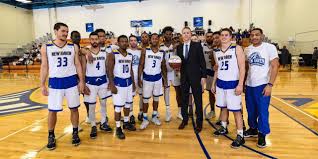
Hotaling does not raise his voice. He rarely needs to. A short instruction, a quick demonstration, and a nod send players back into motion. Practice moves with purpose, shaped by repetition and clarity. The scene feels ordinary on the surface, yet it represents something extraordinary for the University of New Haven. This gym now houses a Division I basketball program, and Hotaling has guided every step of the climb.
The move to Division I marked a defining moment for the Chargers, but the transition also reflected decades of preparation by a coach who never rushed the process. Hotaling’s journey to this moment began long before conference realignment, facility upgrades, or national attention entered the conversation.
“My family was always sports-oriented,” Hotaling says. “I grew up at practice. That was just normal for us.”
Hotaling’s parents shaped that environment. His mother, who grew up before Title IX expanded opportunities for women, brought a sharp understanding of athletics and coaching. His father played three sports in college and later coached at the high school level in upstate New York. Sports defined daily life in the Hotaling household.
“I’ve been at practice every day since I was five years old,” Hotaling says. “Either I managed for my dad or I played. It was just the family business.”
That constant exposure planted a foundation rooted in routine and responsibility. Coaching never felt abstract to Hotaling. Coaching felt familiar. Over time, familiarity turned into curiosity, and curiosity evolved into obsession. Hotaling studied how teams practiced, how coaches communicated, and how leadership shaped culture.
That mindset followed him through each step of his coaching career. Hotaling worked under respected mentors, including Steve Clifford and James Jones, and treated every stop as a classroom.
“You can learn from anyone if you pay attention,” Hotaling says. “You have to be open-minded and take pieces from different people, then make it your own.”
Hotaling still keeps practice plans from every job he has held, stacked neatly inside his office with handwritten notes scribbled along the margins. Those pages capture drills, philosophies, and reminders about how players respond to instruction.
“I’m very curious,” he says. “When you’re around good coaches who are willing to teach, it makes learning easy.”

That approach eventually led Hotaling to the University of New Haven, where he inherited a Division II program and steadily built it with patience and consistency. Wins followed, but Hotaling focused on people before results. He prioritized culture, accountability, and development.
Years later, when the university committed to a move to Division I, Hotaling faced the most demanding challenge of his career. The transition required rapid recruiting, expanded scheduling, and a complete roster overhaul in a matter of months.
“I didn’t have time to sit back and process it,” Hotaling says. “We had to recruit, build a roster, and get ready to compete.”
Hotaling intentionally took control of the roster construction. After an assistant coach departed for Yale, Hotaling decided to evaluate and recruit players himself.
“I wanted to get the people part right before anything else,” Hotaling says. “I knew this would be hard. I wanted players who fit what we do and how we work.”
He signed four Division II players and filled out the remaining roster through relentless outreach and evaluation. Long days turned into late nights, and the work continued without pause. Hotaling embraced the challenge.
“It was actually enjoyable,” he says. “We added good people and good players.”
The increased attention that comes with Division I has not altered Hotaling’s daily approach. Practices look the same. Expectations remain unchanged. Preparation drives everything.
“Regardless of level, we all do the same job,” Hotaling says. “The awareness might change, but the work stays the same.”
Athletic Director Devin Crosby believes that mindset positions New Haven for long-term success.
“Ted Hotaling is a consummate Division I head coach,” Crosby says. “He understands the entrepreneurial nature of NCAA Division I athletics and the broader enterprise of higher education. He is an excellent recruiter, maintains strong relationships across the NCAA, and brings a high-level basketball mind.”
Crosby sees Hotaling as the architect of New Haven’s future at the highest level.
“Under Ted’s leadership, the University of New Haven will compete for NEC championships and position itself for NCAA tournament appearances,” Crosby says. “It is my responsibility to ensure Ted has every resource appropriate for our conference, and I take that seriously. We have something special, and Ted is leading the charge for our basketball program.”
That belief resonates inside the locker room. Players respond to Hotaling’s clarity and consistency, especially during demanding practices that mirror game intensity.
For Jabri Fitzpatrick, Hotaling’s impact shows up daily.
“Ted is an amazing coach,” Fitzpatrick says. “Every day in practice, I see myself and my teammates understand what he teaches. Ted gives me complete confidence, both here and wherever basketball takes me. He always emphasizes taking care of what we need to do.”
Fitzpatrick’s words reflect a program built on trust. Players know what Hotaling expects and why those standards matter. Confidence grows from preparation, not promises.
Moments like hosting Penn State at the Hazel Center underscore how far the program has traveled. Power-conference teams rarely visit smaller gyms, yet New Haven welcomed national competition onto its home floor. The building felt packed, loud, and alive.
Hotaling did not frame the moment as validation.
“I just love coaching,” he says. “I love the work.”
Former players filled the stands that night, reconnecting with a program that shaped their lives. Hotaling noticed them, appreciated them, and then returned his focus to the bench.
“I’m happy for the university,” Hotaling says. “I’m happy people are paying attention.”
The future will bring new challenges, larger expectations, and greater visibility. Hotaling does not dwell on legacy or recognition.
“I’m just the caretaker of the program,” he says. “Someone will replace me someday.”
When that day eventually arrives, Hotaling hopes people remember him simply.
“I just want to be remembered as a basketball coach,” he says. “I love basketball. I love coaching. That’s enough for me.”
 The Jets Setter
Leave a comment